
FYI, due to circumstances beyond our control the UPC Book Club meeting is CANCELED today. Watch this space for a new date and time.
Author: uscwim
USC Women in Management
Empowering the Women of USC since 1979
UPC Book Club reminder and updated location
Room change in Doheny Library:
Next Meeting: Monday, August 10, 2015, Noon to 1:00 Location DML G 28, UPC
WIM Brown Bag Book Club
“Citizen”
by Claudia Rankine ISBN 978-1-55597-690-3
More information https://www.graywolfpress.org/books/citizen
RSVP http://uscwim.org/calendar.asp please and thank you
See you Monday!
More about our current and previous books here:
August 10, 2015: UPC WIM Book Club, next book “Citizen”
WIM Brown Bag Book Club
“Citizen”
by Claudia Rankine ISBN 978-1-55597-690-3
Next Meeting: Monday, August 10, 2015, Noon to 1:00 Location DML G 28, UPC
More information https://www.graywolfpress.org/books/citizen
RSVP http://uscwim.org/calendar.asp please and thank you

Our previous book:
 Review, Cadillac Desert by Marc Reisner
Marc Reisner’s book Cadillac Desert covers the history of water in the Western United States. The book looks at the first white explorers to the grand dams, powerplants, and canals of the US Bureau of Reclamation. Reisner took great pains to document the political machinations through 1986. It is a deep dive into the transformation of the American West from a desert not fit for human life to an agricultural and urban behemoth.
Reisner didn’t hide his opinion: “The drought itself, which may end up a more costly disaster than all of these combined, qualifies best as punishment meted out to an impudent culture by an indignant God.”
He felt that careerist bureaucrats, bloated land barons, greedy politicians “tamed” the wild rivers of the West in the search for cheap water and money. As the free and plentiful water drew more and more people to the desert, the plenty of it became more and more challenged. Surprisingly, not much has changed in the realm of water; the West in the last 30 years. The issues have gotten more pressing as groundwater depletion worsened through years of drought. The state of California is only now taking some of the ideas in this book into accord. But water remains prioritized to farms. Farms which left to nature would be “reclaimed” by the desert in the blink of an eye. Population growth in the Southwest exacerbate the problem to an immeasurable degree.
What struck me through reading was how little has changed. Through a rigged political system, a few wealthy white men pull strings to make their accounts larger, and work in concert with the to affect outcomes in such a grand scale. While we can give most of the people involved the benefit of the doubt, the problems multiply as they try to solve one water issue. Dams work for so long … and then they don’t. Irrigation of the desert might not have been the country’s finest idea. So what do we do next?
Aubrey Hicks
Women speaking
“The voice is our emotional engine. It carries our energy, health, vitality, joy and intelligence. But because our voices are powered by the breath, which is instantly responsive to stress and anxiety, it can also signal our anxiety, fear and self-doubt. Using your voice to convey confidence and authority is a challenge for everyone, of course, but it often has greater implications for women and can hurt their ability to influence and lead.”
Like, totally don’t talk like this to get ahead in business?, by Gina Barnett, Fortune, July 6, 2015
July 6, 2015: UPC WIM Book Club “Cadillac Desert”
Next UPC WIM Brown Bag Book Club Book:
“Cadillac Desert”
by Marc Reisner
ISBN 978-0140178241
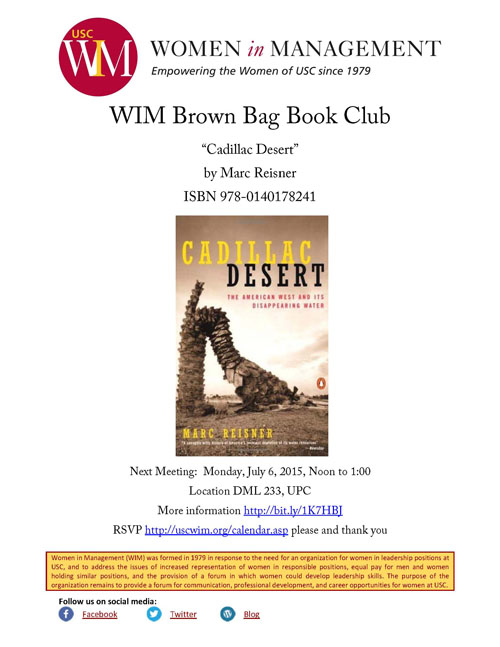
Next Meeting: Monday, July 6, 2015, Noon to 1:00
Location DML 233, UPC
More information http://bit.ly/1K7HBJ
RSVP http://uscwim.org/calendar.asp please and thank you
 From the unique narration or the novel to how Fan represents change – this is one of those novels that has a million and one themes and things to discuss. We compared some of the ideas in this novel to ideas in the film Mad Max: Fury Road and some of the other dystopian stories floating around today’s pop culture (like Hunger Games and Divergent). And for those who missed today’s conversation, you can always check out the LAPL’s Aloud discussion here, or the USC Bedrosian Center’s discussion here.
Continue reading July 6, 2015: UPC WIM Book Club “Cadillac Desert”
Peter Cardon – Speaking and Presenting with Authenticity

Peter Cardon and Jennifer Severa
HSC WIM Professional Development with Peter Cardon
“Speaking and Presenting with Authenticity”
May 18, 2015
Peter Cardon, MBA, PhD, spoke to WIM members about “Speaking and Presenting with Authenticity” over lunch on May 18. Cardon began the presentation with a video clip of the national wrestling champion Andy Robles in action. He then asked for members to respond to what they saw. The wrestler, though missing one leg, used his upper body strength to pin down his opponent. He used his strength to his advantage. Cardon said that is what every speaker, every leader, must do—play to her strengths.
Every person has a unique set of strengths. They define one person from another. Acknowledging and employing these strengths is the first step to becoming an effective and authentic speaker. The next important factor is opening up and connecting with the audience. Cardon mentioned that many times he will watch a student converse openly with other classmates but the moment she steps up to deliver her speech she becomes stiff. Cardon referenced the Wall Street Journal article, “Use Stress to your Advantage,” noting that it is important to embrace the anxiety, the adrenaline, that comes naturally before a presentation. Do not try to fight it. He went on to discuss the importance of responding to the audience in front of you. Note the person in the red coat, or the laughter generated by what has just been said.

However, eye contact and responding to the audience alone is not enough. The speaker has to have a passion for the topic that is being presented. If the speaker is not passionate about a topic, there is no way that the audience will be drawn in to care about the topic either. In addition, it is important to also reveal something about one’s self: a story, a moment of fear, joy, of real life, that the audience can connect and relate to. In speaking, as in writing, the strength is in telling the truth of the matter.
Cardon shared two video clips of strong female leaders in action: IBM’s Ginna Rommety (“A New Era of Value: A Conversation with Ginna Rommety, NRF 2014 Keynote”) and Chairman and CEO of PepsiCo, Indra K. Nooyi (Address to the Economic Club of Washington). Each woman had her own style, however, each used the traits of an effective and authentic speaker. She connected and responded to the audience. She played to her strengths. She spoke with passion about the subject and revealed herself with personal moments that the audience too could relate to on a more personal, human level.
WIM members were asked to consider the following questions:
1. What is one of your strengths (with a focus on a positive and valued trait) that you rarely employ when you present to others? Why?
2. What is one of your strengths that you use often in presentations that you could pair with another trait to position you even better? Explain.
3. What narrative about yourself can you reveal to others that will position you to present more effectively?
The hour came to a close and Cardon concluded: “All of this takes practice.” He said that the most effective way to improve presentation skills is to videotape one’s self in action. Cardon said that emerging technology will require that leaders speak with authenticity. In the future, leaders will be expected to deliver video blogs rather than written memos. A person’s ability to speak with authenticity will determine her success.
By Kristine Hren Moe

Active Listening: Let the Speaker Fill the Space

Report by Kristine Moe
On Thursday morning, April 30, Los Angeles-based professional coach and actor, and Associate Director of Learning and Development at the USC Marshall School of Business, Joshua Knightley, led a seminar on Active Listening. As managers, Knightley said, we are problem solvers. Sometimes we need to do things quickly, get the problem solved and move on. However, as managers we also need to develop our own people, and let them solve problems on their own. We can do this by honing our “active listening” skills.
Continue reading Active Listening: Let the Speaker Fill the Space
WIM Book Club: next meeting, March 2, next book, “Thinking Fast and Thinking Slow” parts 1-3
 Next meeting: Monday, March 2, 2015
Norris Library West Conference Room
Noon to 1
Next book: Thinking Fast and Thinking Slow
By Daniel Kahneman
ISBN: 978-0374533557
More information: http://us.macmillan.com/thinkingfastandslow/DanielKahneman
Please RSVP at http://www.uscwim.org/calendar.asp
Thinking Fast and Thinking Slow is a long book, so we’ll only be discussing parts 1-3 of at this meeting.
Click here or on the image for a pdf flyer
At our last meeting on January 27 we discussed:
“Michael Connelly’s The Burning Room is the 19th in the series which follows Los Angeles Detective Harry Bosch. In this iteration, Harry is in a newly minted cold case squad and partnered with a rookie (perhaps trigger happy) partner named Lucia Soto. They are given a case after the death of Orlando Merced, a mariachi performer, who had been shot nearly a decade ago in Mariachi Plaza. His shooting sparked political change but was never solved. Now that they have the physical evidence from his body, they can try to trace the weapon.
 “While they are working on this case, Bosch discovers a personal case that Soto is looking into – another decades old case in which several children were killed in a fire. They work on both cases, following divergent trails that lead them into murky waters of the past.
“During our conversation there were mixed reviews. There were a few who found this very dark with very little redemption and that the resolution was uneventful and unsatisfying. Others found the book realistic, and were familiar with the way Connelly writes the Bosch character. Some found it not to have literary merit, though 19 in a series does seem to speak to staying power.
“The group all seemed to enjoy the Angelino nature of the book, with specific set locations in the city that made the novel seem more real somehow. Perhaps that’s why the lack of resolution is so difficult to read?”
Recap by Aubrey Hicks Thank you, Aubrey!
WIM Book Club: Next Book and Next Meeting
Next WIM Book Club meeting:
DATE: Monday, January 26, 2015
LOCATION: Norris Medical Library, West Conference Room
TIME: Noon to 1:00
BOOK: The Burning Room, by Michael Connelly
AND we will be deciding the next book, so please RSVP http://uscwim.org/calendar.asp so we can know your suggested book before the club meeting.
Something to read over the holidays!

“What do you do with a tired old cop? You give him a bright young rookie to keep him on the ball. In return for this infusion of energy, the kid gets the benefit of the broad experience and infinite wisdom of the veteran. That’s the way it’s supposed to work, anyway. But in THE BURNING ROOM, Michael Connelly’s latest Harry Bosch mystery, there’s precious little wisdom the L.A.P.D. detective can impart to his new partner, Lucia (Lucy) Soto, about the curious case of a homicide victim who took 10 years to die.”
New York Times Sunday Book Review

Our previous book:
 At our meeting on December 8, 2014, we discussed Stephen Hawking’s memoir, “My Brief History,” a book we all enjoyed very much, but most of us would never have read if it wasn’t the club choice. Dr. Hawking writes in a dry, wry style that might be because he’s British, or possibly because his communication software only allows him to generate three words per minute. Either way, it’s a delightful book and due to the work that went into writing it, we’re lucky to have it. One thing that struck all of us is that Dr. Hawking writes, in this book, like he’s still the happy young guy on the cover, maybe a little older, but still that guy. Although WIM are intelligent, educated, sophisticated women of the world, we all admitted to being somewhat puzzled by the one small chapter on Dr. Hawking’s science. We had to look up some of the words, and even so, it wasn’t much clearer. More comprehensible were his working relationships with his fellow scientists and how, even when in competing areas or areas of disagreement, they kept their sense of humor, and kept the science first and foremost. “My Brief History” is a fast read, delightful and informative (even or especially the science chapter). Highly recommended.
2014 USC Women Deans’ Panel
WIM was pleased to host the 2014 USC Women Deans’ Panel in the University Club Scriptorium on December 12.

Left to right: Erica Muhl; Madeline Puzo; Marilyn Flynn; Karen Symms Gallagher; Catherine Quinlan
Continue reading 2014 USC Women Deans’ Panel